͏‌ ͏‌ ͏‌ ͏‌ ͏‌ ͏‌ ͏‌ ͏‌ ͏‌ ͏‌ ͏‌ ͏‌ ͏‌ ͏‌ ͏‌ ͏‌ ͏‌ ͏‌ ͏‌ ͏‌ ͏‌ ͏‌ ͏‌ ͏‌ ͏‌ ͏‌ ͏‌ ͏‌ ͏‌ ͏‌ ͏‌ ͏‌ ͏‌ ͏‌ ͏‌ ͏‌ ͏‌ ͏‌ ͏‌ ͏‌ ͏‌ ͏‌ ͏‌ ͏‌ ͏‌ ͏‌ ͏‌ ͏‌ ͏‌ ͏‌ ͏‌ ͏‌ ͏‌ ͏‌ ͏‌ ͏‌ ͏‌ ͏‌ ͏‌ ͏‌ ͏‌ ͏‌ ͏‌ ͏‌ ͏‌ ͏‌ ͏‌ ͏‌ ͏‌ ͏‌ ͏‌ ͏‌ ͏‌ ͏‌ ͏‌ ͏‌ 
Is this email not displaying correctly? View it in your browser.
Logo
Image description

Chapala Birders News - May 2026

Community News & Sightings

Species Sighted Last Month by Duncan Poole

There were 174 species reported this past month for the lake area. The complete list is shown at the end of this newsletter.  Interesting species sighted:

  • American Herring Gull

  • Purple Gallinule

  • Aztec Rail


Birding Trivia! Merlin vs BirdersTest your knowledge with this fun trivia game.


May 9th is Global Big Day! Plan to participate in this fun event and share the birds you find with eBird on this annual celebration. Learn more!


Thank you for the Donations💸💰

We are extremely grateful for all donations to cover the costs of the Website hosting and the newsletter. Many thanks to Jim Pike for his recent donation. If you wish to donate, please give it to your birding leader to add it to the donation box, or email [email protected] for options.

Feature Birds: Hummingbirds  by Jules Evens

Image description

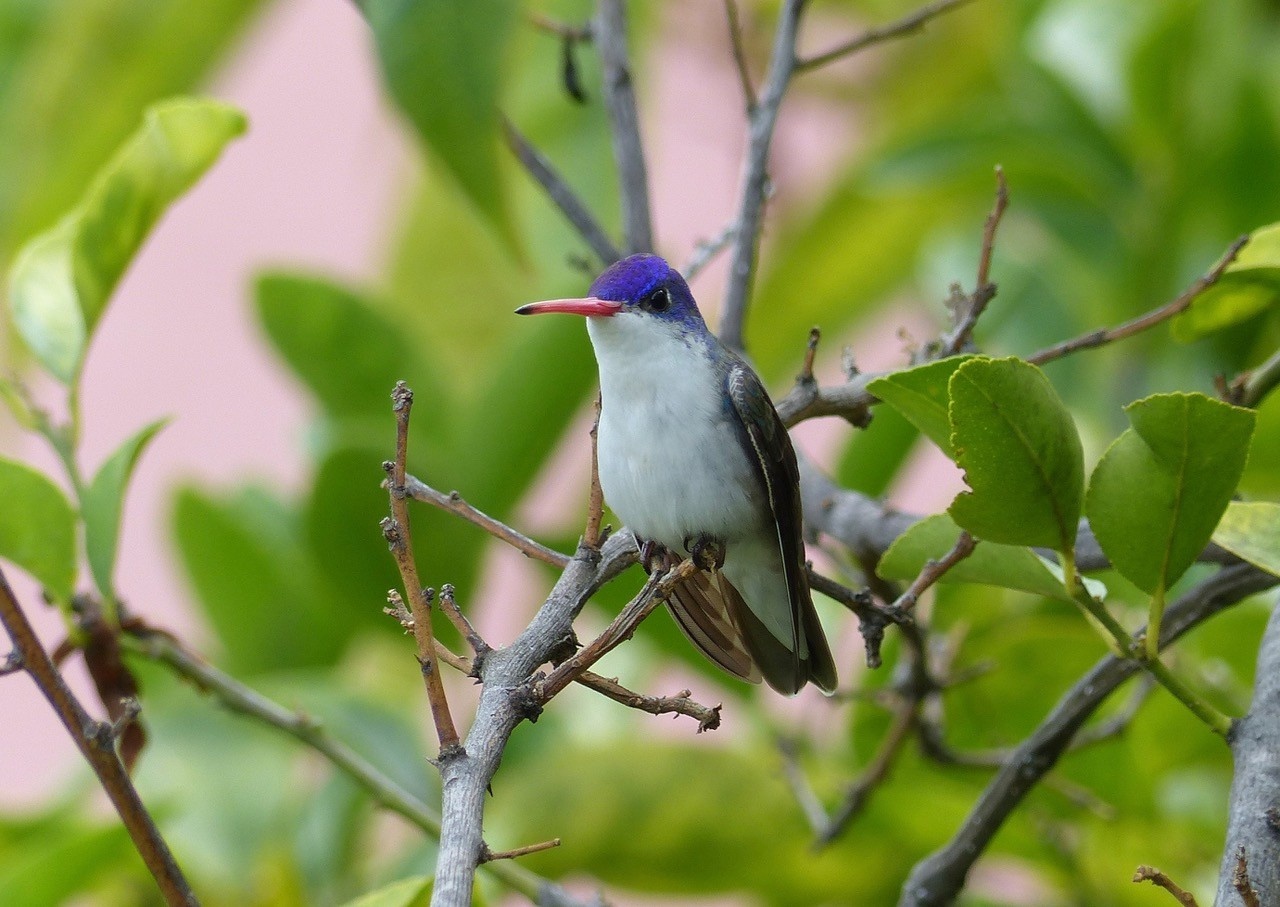
Violet-crowned Hummingbird    (Ramosomyia violiceps) [VCHU]

Our Hummingbirds

Hummingbirds are revered in Mesoamerican cultures. To the Maya, the hummingbird  (ts’unu’um) is sacred, fashioned from jade by the gods as a messenger of thoughts, wishes, and love. To the Aztecs (Huitzilopochtli from Nahuati), the sun and war god, embodying dead warriors. In Mexico there are 58 species, 12 of which are endemic. Nine species occur regularly in the Lake Chapala area, but two are by far most common—Violet-crowned and Broad-billed hummingbirds (pictured in this article). Both species forage primarily on nectar and arthropods throughout the year. Hybrids have been reported, though rarely.


The Violet-crowned (Ramosomyia violiceps) [VCHU] is the slightly larger of the two (weighing less than a 10 peso coin!) and the more aggressive (war-like). Distinguished from other species by its immaculate white underparts, iridescent bluish-violet crown, and red bill with a black tip. The sexes are similar although the crown iridescence may be slightly brighter in males. Though sexes are indistinguishable, based upon behavior of other hummers, females are presumed to do all the incubation. Weight ~5 gms, (two pesos!). It is mostly resident throughout its range along the Pacific slope from the southern-most U.S., through Sonora and Jalisco south to Oaxaca. As with some other hummingbird species, the distributional range of VCHU appears to be expanding northward.


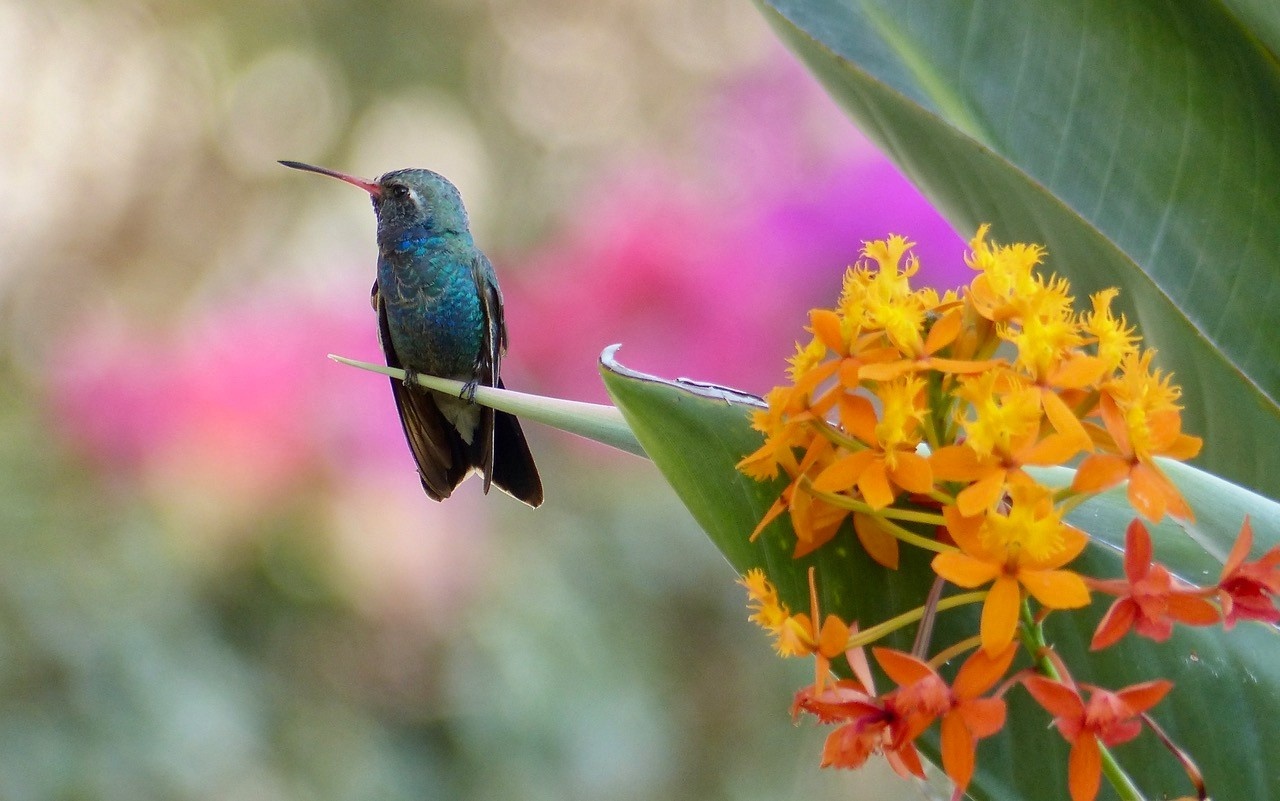
Broad-billed Hummingbird (Cynanthus latirostris) [BBHU], is smaller than the VCHU at only 3 to 4 grams, but like the VCHU has a red bill. Sexes are dissimilar (dimorphic). The male plumage shimmers in iridescent and metallic blues and greens throughout. The female is duller with some iridescence on the back and tail, gray underparts, and a black-and-white facial pattern. The distributional range is similar to the VCHU, breeding populations throughout most of Mexico are resident, but prone to wandering and occurs occasionally as far north as Canada, as a vagrant. More northerly populations (in the southern US and northern Mexico) are migratory moving southward in winter months.


As befits the Aztec’s god of war, the larger VCHU is more aggressive and tends to dominate, especially at feeders. Watching the behavior at our feeders is entertaining. The VCHU, in particular, seems to spend as much or more energy chasing others from its chosen feeder as he does foraging. BBHU is invariably subordinate.


Other species that occur regularly in our area include Ruby-throated, Black-chinned, Rufous, Broad-tailed, White-eared, Berylline, and Mexican Violetear hummingbirds.

Image description

Broad-billed Hummingbird: male     (Cynanthus latirostris) [BBHU]

For more information on Hummingbirds, check out this video "Extreme Hummingbirds" by Cornell Lab Bird Academy. (If you get a "Sorry" error message, try another browser to view it).

Tip #10 for Birding Ethics

Approach birds with care. Be respectful of the bird's habitat and tranquility, and avoid "flushing out" birds (making them fly) in order to get that better photograph. Flushing out a bird uses up precious energy they may need for feeding and safety.

Observe them quietly and cautiously.

You can learn more about the impacts of flushing out birds.

Learn more here overall about Birding Ethics.

Upcoming Bird Trips

Our bird-walks are open to all those interested in birds; beginners & experienced birders. We always have knowledgeable birders on hand to identify the species. We have a limited number of extra binoculars available upon request in advance of trip.

————

During these outings social conversations are limited so we do not scare the birds we are observing. Birders can gather for coffee or a meal to socialize later.

————

We try to limit most car trips to 3-4 vehicles / 12-16 people. Larger convoys are hard to manage. If you are being given a ride, you are expected make a contribution to your driver for gas and tolls ($100 - $400 pesos based on length of trip).

1st SUNDAY OF EVERY MONTH: On May 3rd there will be an informal birding walk along the Allen Lloyd Trail. Meet up at 8am with local and visiting birders in this very accessible location. Expect to see Blue Mockingbird, Happy Wren, and sometimes a Russet-crowned Motmot or Squirrel Cuckoo.

How to get to the trail head: Drive up the Libramiento a half mile (1 km) from the traffic light at Walmart, then turn left (carefully) as you would for the hospital (Ribera Medical Center). Double back and drive up the left side of the hospital. Keep going uphill another half mile, and park on the only street to your left. Here is a pindrop.  (Note: after parking, we'll walk up the road past the construction. The trail is obliterated, but the birding is still good).


On Tuesday, May 12th, meet team leader Cheshta Buckley at 8:00am at the San Antonio Malecon parking lot to walk the Malecon area and the field north of it. Expect to see a variety of herons, egrets, and other shorebirds, as well as songbirds. At about 10am we will complete the bird list. Please confirm your attendance at least 2 days in advance with Cheshta at [email protected] 

How to get to the parking lot: In San Antonio Tlayacapan along the Carretera, turn toward the lake at the light on Calle San José and drive approx 3 blocks to Calle La Paz and turn right. Go one block to Calle Colón and turn left to the parking lot at the lakeshore. (see pindrop).


On Tuesday, May 19th, meet team leader Gerd DeBeer at 8:00am at the “Sculpture” (see pindrop). It’s at the only traffic light in La Floresta, opposite Restaurant Pranzo). We will depart immediately for La Manzanilla de la Paz on the south side of the lake, enroute to Mazamitla. Expect to see a variety of hawks, woodpeckers, sparrows, warblers and wrens. We will park and walk the lower half of the creek path. Then return to our vehicles for a refreshment break. Then walk up to the Presa and bird there until 1pm for lunch  (approximately 2.5 km in total). Bring your own mid-morning refreshments and bag lunch. We’ll be back in Ajijic about 3:00pm.

You must reserve at least 2 days ahead as there will be a maximum of 12 people. Please email Gerd at [email protected] indicating if you can bring a vehicle and can take others, or if you would like to be a passenger. (We don't always have enough cars). Each passenger pays the driver $200 pesos to cover gas/tolls.

Bird Trip Summaries for April by Trip Leaders

On Sunday, April 5th, a group of 16 people showed up for the first Sunday of the month informal bird walk up Allen Lloyd canyon. It was a great walk with 44 species observed including Mexican Squirrel Cuckoo and a Russet-crowned Motmot front and center. The day was sunny, warm and calm. We had a family come from Guadalajara, someone from London, another from Boulder, Colorado just to name a few places where people were from. Great group. Nice sightings. Good time.  (report offered by the Andersons) See checklist


On Tuesday, April 7th, a group of 13 birders were led by team leader Duncan Poole to Estación de Bombeo. Warblers still around, including Nashville, Yellow-rumped, and Northern Yellow. The flooded field is shrinking, still holds numerous shorebirds, including a Herring Gull, Semipalmated Plovers, 6 heron species, Long-billed Dowitchers, 4 species of ducks. The birds were in their full plumage - beautiful Black-backed Oriole (male), Western Tanager (male), even the Yellow-rumped Warbler (male), were striking. A total of 74 species were observed!  See full list here 


On Friday, April 17th, 7 birders joined team leader Robert Taylor to walk the Cristiana Park. In spite of the spoilage of the favorite marsh area caused by the dumping of waste from the construction we still managed to observe 41 species which included a good number of shore birds plus a Black-headed Grosbeak, Yellow warbler and a Western Grebe.  See full checklist


On Wednesday, April 22nd, 10 birders included visiting birders from Western Australia, Alaska and Argentina. They met with team leader Cheshta Buckley and walked the El Bahio neighbourhood. A total of 39 species were observed, and while most warblers have already passed through, they were treated to 10 Western Warbling Vireos actively foraging at close range.  El Bahio continues to surprise.  For a full list of species, click here.

Monthly Sightings 

by Duncan Poole

What is the “Lake Chapala Area” for bird sightings?

We define it as the whole area of the lake plus all land within 15 km (7 miles) from the edge of the lake. We combine sightings for the month from Chapala, Jocotopec, Ixtlahuacán de los Membrillos, Briseñas, Venustiano Carranza, Poncitlán, Ocotlán, Jamay, & La Manzanilla de la Paz.


174 species were observed around Lake Chapala in April. (in Taxonomic order):

1      Black-bellied Whistling-Duck

2      Fulvous Whistling-Duck      

3      Garganey

4      Blue-winged Teal

5      Cinnamon Teal

6      Northern Shoveler

7      American Widgeon

8      Mexican Duck

9      Green-winged Teal

10    Northern Bobwhite

11    Rock Pigeon

12    Eurasian Collared-Dove

13    Inca Dove

14    Common Ground Dove

15    White-tipped Dove

16    White-winged Dove

17    Mourning Dove

18    Groove-billed Ani

19    Greater Roadrunner

20    Mexican Squirrel-Cuckoo

21    Buff-collared Nightjar

22    Vaux's Swift

23    Rivoli's Hummingbird

24    Broad-billed Hummingbird

25    Violet-crowned Hummingbird

26    Berylline Hummingbird

27    Aztec Rail

28    Sora

29    Common Gallinule

30    American Coot

31    Purple Gallinule

32    Black-necked Stilt

33    American Avocet

34    Killdeer

35    Semipalmated Plover

36    Collared Plover

37    Northern Jacana

38    Long-billed Dowitcher

39    Spotted Sandpiper

40    Lesser Yellowlegs

41    Greater Yellowlegs

42    Stilt Sandpiper

43    Least Sandpiper

44    Laughing Gull

45    Ring-billed Gull

46    American Herring Gull

47    Caspian Tern

48    Forster's Tern

49    Royal Tern

50    Pied-billed Grebe

51    Western Grebe

52    Neotropic Cormorant

53    White-faced Ibis

54    Roseate Spoonbill

55    Least Bittern

56    Black-crowned Night Heron

57    Little Blue Heron

58    Tricolored Heron

59    Snowy Egret

60    Green Heron

61    Western Cattle-Egret

62    Great Egret

63    Great Blue Heron

64    American White Pelican

65    Black Vulture

66    Turkey Vulture

67    White-tailed Kite

68    Sharp-shinned Hawk

69    Red-tailed Hawk

70    Great Horned Owl

71    Ferruginous Pygmy-Owl

72    Russet-crowned Motmot

73    Gila Woodpecker

74    Golden-fronted Woodpecker

75    Ladder-backed Woodpecker

76    Crested Caracara

77    American Kestrel

78    Merlin

79    Monk Parakeet

80    Northern Beardless-Tyrannulet

81    Greenish Elaenia

82    Least Flycatcher

83    Western Flycatcher

84    Vermilion Flycatcher

85    Dusky-capped Flycatcher

86    Nutting's Flycatcher

87    Brown-crested Flycatcher

88    Great Kiskadee

89    Social Flycatcher

90    Tropical Kingbird

91    Cassin's Kingbird

92    Thick-billed Kingbird

93    Western Kingbird

94    Golden Vireo

95    Cassin's Vireo

96    Plumbeous Vireo

97    Western Warbling Vireo

98    Loggerhead Shrike

99    Common Raven

100  Tree Swallow

101  Northern Rough-winged Swallow

102  Barn Swallow

103  Bushtit

104  Blue-gray Gnatcatcher

105  Canyon Wren

106  Northern House Wren

107  Marsh Wren

108  Bewick's Wren

109  Spotted Wren

110  Happy Wren

111  Sinaloa Wren

112  Blue Mockingbird

113  Curve-billed Thrasher

114  Northern Mockingbird

115  Orange-billed Nightingale-Thrush

116  American Robin

117  Rufous-backed Robin

118  House Sparrow

119  American Pipit

120  Elegant Euphonia

121  House Finch

122  Lesser Goldfinch

123  Stripe-headed Sparrow

124  Chipping Sparrow

125  Clay-colored Sparrow

126  Lark Sparrow

127  White-crowned Sparrow

128  Savannah Sparrow

129  Lincoln's Sparrow

130  Rusty-crowned Ground-Sparrow

131  Canyon Towhee

132  Yellow-breasted Chat

133  Yellow-headed Blackbird

134  Black-vented Oriole

135  Orchard Oriole

136  Hooded Oriole

137  Streak-backed Oriole

138  Bullock's Oriole

139  Black-backed Oriole

140  Red-winged Blackbird

141  Bronzed Cowbird

142  Brown-headed Cowbird

143  Brewer's Blackbird

144  Great-tailed Grackle

145  Northern Waterthrush

146  Black-and-white Warbler

147  Orange-crowned Warbler

148  Lucy's Warbler

149  Nashville Warbler

150  Virginia's Warbler

151  MacGillivray's Warbler

152  Common Yellowthroat

153  American Redstart

154  Northern Parula

155  Northern Yellow Warbler

156  Yellow-rumped Warbler

157  Black-throated Gray Warbler

158  Townsend’s Warbler

159  Rufous-capped Warbler

160  Wilson's Warbler

161  Red-faced Warbler

162  Painted Redstart

163  Hepatic Tanager

164  Summer Tanager

165  Western Tanager

166  Flame-colored Tanager

167  Black-headed Grosbeak

168  Blue Grosbeak

169  Lazuli Bunting

170  Indigo Bunting

171  Varied Bunting

172  Painted Bunting

173  Blue-black Grassquit

174  Cinnamon-rumped Seedeater

John and Rosemary Keeling

John and Rosemary Keeling

Lake Chapala Birders is an informal group of bird observers led by a team of volunteer Chapala Birders on behalf of John & Rosemary Keeling.


Overall Coordinator: Cheshta Buckley

Newsletter: Mugs McConnell

Website: Robert McConnell

Feature Bird: Jules Evens

Monthly Sightings List: Duncan Poole

Bird Trip Leaders & Reports: Cheshta Buckley, Thomas Bravo, Kate & Carl Anderson, Jules Evens, Duncan Poole, John Roynon, Robert Taylor, Robert McConnell, Gerd DeBeer.

Illustrated color folders showing our common birds are available for $200 pesos from your birding group leaders on bird walks. Also available at Diane Pearl’s Gallery, 11am to 4pm, Santa Margarita #23, Riberas del Pilar.


Sign up for this newsletter or send us your exciting bird sightings by visiting our contact page


Check our website: ChapalaBirders.org  There you will find our newsletters, illustrations of our birds and advice on buying binoculars, books & birding apps.

Image description
Image description

Copyright (C) 2026, Lake Chapala Birders. All rights reserved.
Our mailing address is: Calle Santa Isabel #32, Riberas del Pilar (Ajijic), Chapala, JA, 45906 MX

To sign up for this newsletter, go to our website contact page

If you would like to unsubscribe, please click here.
Powered by Sender.net